Practical
How to Stop a Dumpster Wrecking Your Driveway
A loaded roll-off puts several tons on four small steel contact points. Florida driveways are thinner than most, and a very large share of them are pavers.
Why this matters more in Florida
Two things make Central Florida driveways more vulnerable to roll-off containers than driveways in most of the country.
The first is slab thickness. Without a freeze-thaw cycle to design around, residential driveway slabs here are frequently poured thinner than in northern states, and often with lighter reinforcement or none at all. A four-inch unreinforced slab on sandy subgrade is a common specification in the older Osceola County subdivisions.
The second is pavers. Brick and concrete paver driveways are enormously popular across the 1990s-onwards housing stock — Celebration, Reunion, ChampionsGate, Hunters Creek, most of the vacation home market and a good share of Poinciana. Pavers are set on a compacted sand bed, and sand under concentrated load does exactly what you would expect it to do.
How the damage actually happens
People picture the container's weight spread across its footprint. It is not. A roll-off sits on two steel rails, and the load concentrates at a small number of contact points — typically the rear wheels and the front of the rails.
A 20 yard container loaded to four tons, plus the container's own weight, puts something in the order of several thousand pounds onto each of those points. That is a point load, and point loads are what crack slabs and dish paver beds.
There are three distinct damage mechanisms:
- Static load. The container sitting there over days, gradually pressing into a sand bed or flexing a thin slab.
- Dynamic load during delivery. The moment the container rolls off the truck and the rear wheels touch down is the highest instantaneous load of the whole rental.
- Dragging. Winching the container back onto the truck drags the rails across the surface. On stamped or decorative concrete this is what causes scoring.
What protection boards do
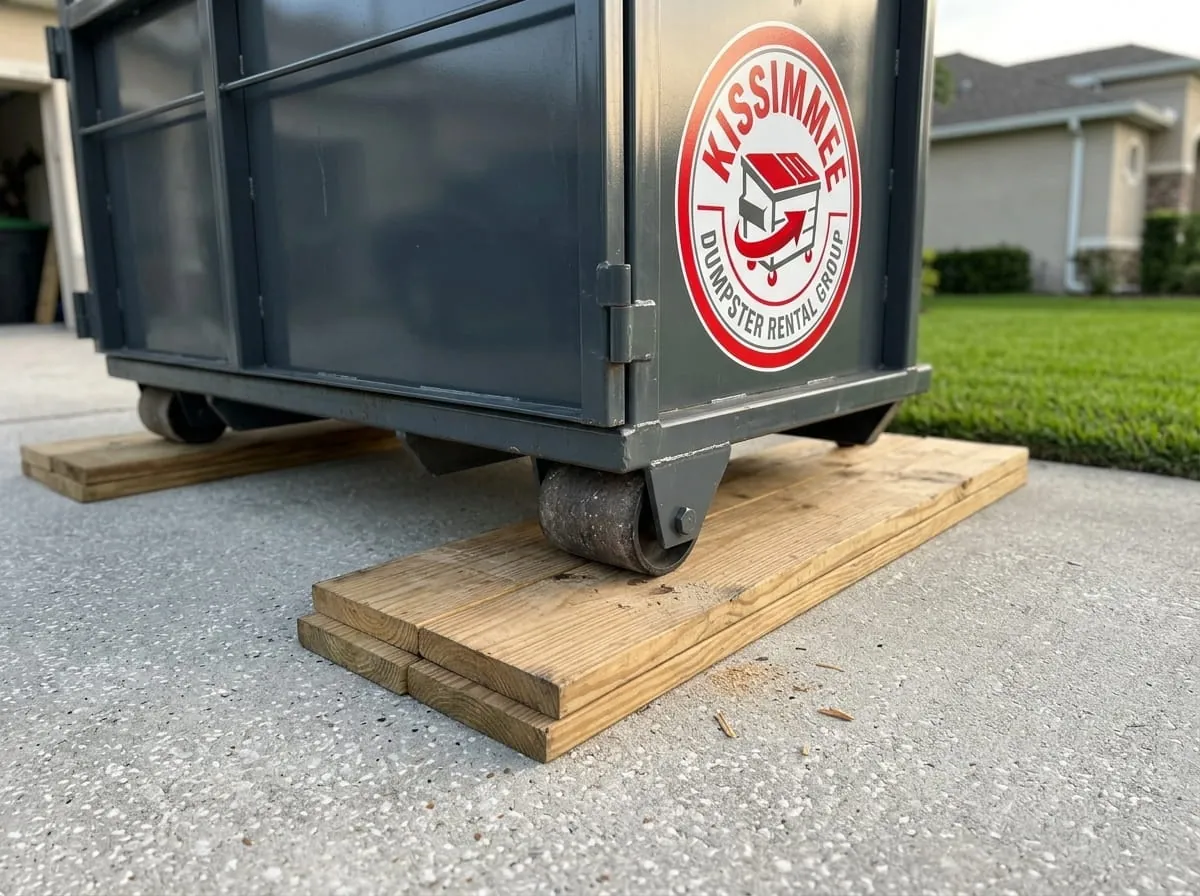
Plywood under the rails spreads a point load across a much larger area. It is unglamorous and it is extremely effective — it is the difference between several thousand pounds on four small contacts and the same weight distributed across several square feet.
Our drivers carry plywood on every truck as standard equipment. Boards go down before the container touches the surface, not afterwards, and they go down again on collection because the drag-on is as damaging as the drop-off.
On pavers and stamped concrete we double up. It costs us a few dollars a job. It has saved a considerable number of driveways.
Surface by surface
Standard concrete driveway
Generally fine with boards down. Watch for existing cracks — a slab that is already cracked will preferentially fail along that line. Point out any cracks to the driver and we will site the container away from them.
Brick or concrete pavers
The highest-risk surface. The pavers themselves are strong; the sand bed is not. Without boards you get depressions that require lifting and re-levelling. With boards, in our experience, problems are rare. This is standard on every Celebration and Reunion delivery.
Stamped or decorative concrete
Structurally similar to standard concrete but the surface finish is the asset. Scoring from rail drag is the main risk. Doubled boards, and we lift rather than drag where possible.
Asphalt
Less common residentially here but present on some commercial sites and rural properties. Very vulnerable in summer heat — asphalt softens and a container will press in. If your surface is asphalt and it is August, consider placing on grass or gravel instead.
Grass, sand and shell
Perfectly workable in dry conditions and common on the acreage properties out toward Narcoossee, Harmony and Intercession City. After sustained rain, the risk moves from surface damage to ruts and a stuck truck. We may recommend placing nearer the road.
Gravel and lime rock
Generally the most forgiving surface of all. Some displacement, easily raked back.
What to check before delivery day
- Sweep the placement area. Grit and stones under boards concentrate load.
- Note existing damage. Photograph cracks and defects before delivery. Not because we expect a dispute, but because it removes the question entirely.
- Move vehicles and anything else in the approach path, including bins and basketball hoops.
- Check overhead. Roughly twenty-two feet of clearance is needed to tip the bed. Low branches and power drops are the most common cause of a placement moving.
- Identify irrigation heads in the approach if the container is going on grass.
- Tell us about the surface when you book. “It is pavers” changes what the driver prepares.
What is underneath the driveway
This is the one people forget and it matters in Florida more than most places.
Septic systems. Never place a container over a septic tank or drain field. The weight can crush a tank lid or compact the drain field, and the repair costs run into thousands. If you are on septic — common in unincorporated Osceola County, Narcoossee and the rural parcels — know where it is.
Irrigation lines. Shallow-buried and easily crushed, particularly in a lawn placement.
Utility service laterals. Water, sewer and increasingly fibre are often shallower than people expect near the house.
Culverts and swale crossings. Many Osceola County driveways cross a drainage swale on a culvert pipe. That crossing is frequently the weakest point of the whole driveway, and a loaded roll-off parked on it is asking for a collapse. Tell us if you have one and we will place past it.
If something does go wrong
It is uncommon, but it happens. What matters is how it is handled.
Tell us straight away rather than after the container is gone. Photograph it. We are licensed and insured, and where damage results from our placement we deal with it rather than arguing about it. Having before-and-after photographs makes that conversation short and civil, which is why we suggest taking the before ones.
What we cannot take responsibility for is damage from a hazard nobody told us about — a septic tank we did not know was there, a culvert crossing we were not warned about. Which is why the two minutes of conversation at booking genuinely matters.
The short version
- Boards go under the rails on every delivery. If a hauler does not do this as standard, use a different hauler.
- Pavers are the highest risk surface and need doubled boards.
- Sweep the area, move vehicles, check overhead clearance.
- Photograph existing damage before delivery.
- Know where your septic, irrigation and culvert are, and say so.
- Tell us the surface when you book — it changes what the driver brings.
None of this is complicated and almost all of it is free. Call and mention your driveway surface when you book and it becomes part of the job rather than a problem on the day.
Need a container in Kissimmee?
Call and describe the job. Three minutes on the phone gets you a size recommendation, a flat rate and a delivery window — and we will tell you if a smaller, cheaper container is the right answer.
Call (689) 215-8855