
Property management
Refreshing a Vacation Rental: The Turnover Cleanout Playbook
Osceola County has one of the densest concentrations of short-term rental homes in the country. Refreshing them is a logistics problem with a very short window.
Why this market is different
The corridor running west from Kissimmee along US 192 and US 27 — Four Corners, ChampionsGate, Reunion, Windsor Hills, Emerald Island, Solterra and the surrounding developments — contains one of the densest concentrations of short-term rental homes anywhere in the United States. Tens of thousands of properties, most of them four to eight bedrooms, most of them professionally managed, all of them turning over constantly.
That produces a category of work that does not really exist in most markets: the turnover refresh. It is not a renovation and it is not a cleanout in the domestic sense. It is a high-volume, low-weight, tightly-timed strip-and-replace, and the constraints are completely different from a homeowner project.
The refresh cycle and what it produces
Rental homes take enormous punishment. A property sleeping twelve, occupied forty-five weeks a year, wears out soft furnishings in a fraction of the time a family home would. Most management companies run some version of a refresh cycle:
- Mattresses every three to five years, sometimes faster
- Sofas and upholstered furniture every three to four years
- Pool and patio furniture every two to three years — Florida sun destroys it
- Carpet and soft flooring every three to five years, often replaced with LVP
- Small appliances, cookware and linens continuously
- Full interior refresh every five to eight years, or on sale
The resulting waste stream is very consistent: bulky, awkward, and light. Mattresses, box springs, sofas, sun loungers, rugs, flat-pack furniture, pool noodles, cookware, and an enormous quantity of packaging from whatever replaced it all.
Weight is almost never the constraint. Volume always is.
The scheduling constraint nobody else has
Here is what makes this work genuinely different. A homeowner renovating a kitchen can have a container for a week and nobody minds. A rental property has guests checking out Saturday morning and checking in Saturday afternoon, or if you are lucky, a three-day gap.
The container has to arrive, be filled, and be gone inside that window. A container still sitting on the driveway when guests arrive is a review problem and, in many communities, an HOA problem.
So the pattern we run for this market is:
- Delivery on checkout morning, often before 9am
- Crews load through the day
- Collection the following morning, or same evening on tight turns
Same-day delivery and next-morning collection is a routine request here rather than an exceptional one, and any hauler serving this corridor should be set up for it. If they are not, they will let you down at exactly the wrong moment.
Sizing a turnover container
Because the material is bulky and light, this is one of the few areas where you should consistently size up.
| Job | Size |
|---|---|
| Mattress and bedding swap, 4–6 bedrooms | 15 yard |
| Living area furniture refresh | 15–20 yard |
| Pool deck and patio furniture replacement | 15 yard |
| Carpet removal, whole house | 20 yard |
| Full interior refresh, 4–6 bed | 30 yard |
| Full interior refresh, 7–10 bed | 30 yard + swap |
| Post-sale full strip-out | 30 yard + swap |
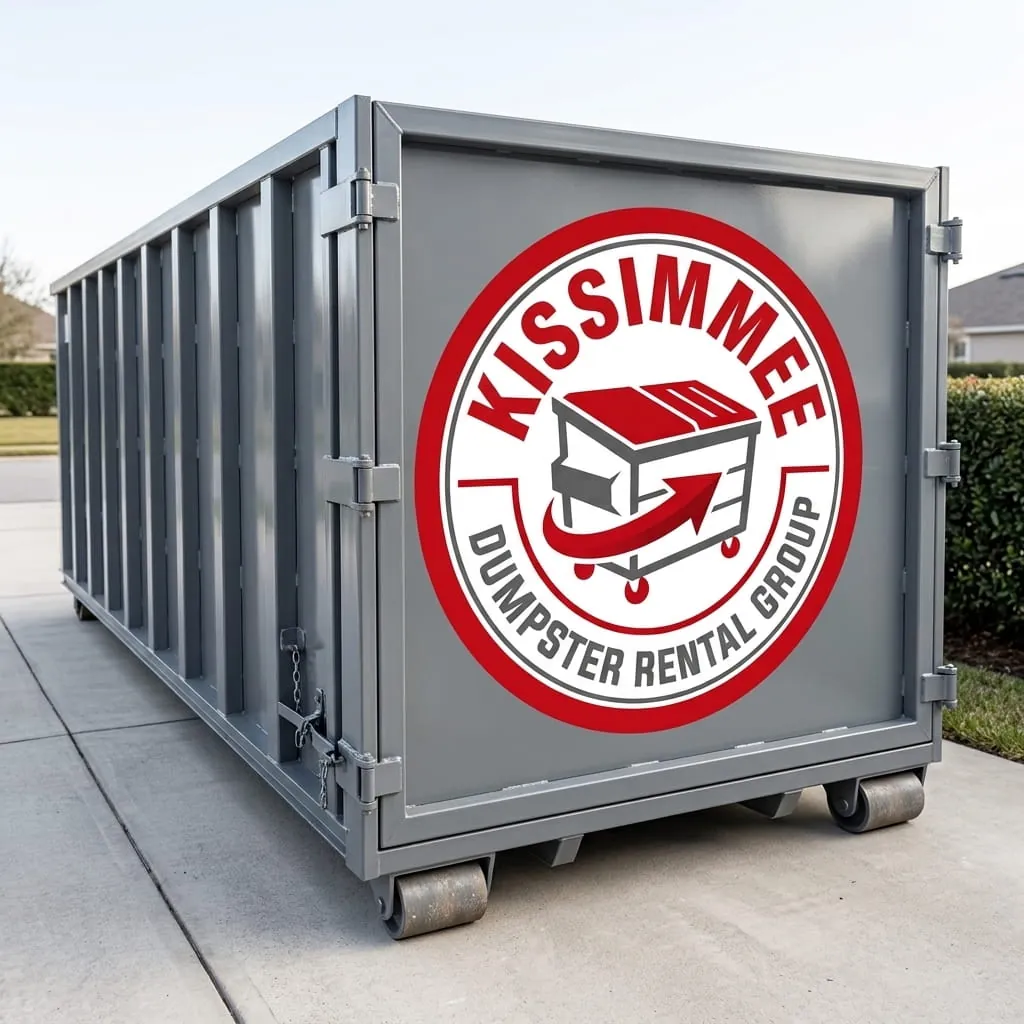
A 30 yard is the same footprint as a 20 — twenty-two feet long — just eighteen inches taller. On the wide driveways typical of this housing stock, if a 20 fits then a 30 fits, and it holds half again as much. For volume-driven work that is straightforwardly better value.
The one thing to plan for is loading height. Six-foot sides mean you should use the rear swing doors and walk mattresses and sofas in rather than lifting them over the wall. Brief the crew.
Gate access and community rules
Almost every community in this corridor is gated, and most have active management with clear expectations. The practical requirements:
- Gate access — a code, a place on the visitor list for the delivery date, or a call-in number our dispatcher can use while the driver is en route.
- Placement — tight to the garage, off the street, minimally visible.
- Duration — short. Several communities have explicit limits and most have an expectation.
- Driveway surface — overwhelmingly pavers in this market. Protection boards matter here more than almost anywhere. More on that here.
Communities worth knowing individually: Reunion has decorative driveways and curved approaches that genuinely need placement planning. ChampionsGate is gate-managed with tight visibility expectations. Four Corners spans four counties, so if street placement ever comes up the answer depends on the street.
Multi-property portfolios
If you manage more than a handful of properties, calling in each job individually is a waste of your time and ours. Standing arrangements work better.
What that typically looks like: an agreed number of container movements per month across the portfolio, a single point of contact on both sides, consolidated invoicing, and a shared calendar of turnover dates so we can plan routes rather than reacting.
The practical benefit is capacity. When you have a standing arrangement, your jobs are already in our schedule. During peak season — and especially in the weeks after a storm, when everything gets tight — that matters a great deal.
We run this for several management companies in the corridor already. Ask for it when you call and we will price it as a package rather than job by job.
What to keep out of the container
Turnover waste is mostly straightforward, but a few things recur in this market specifically:
- Pool chemicals. Every one of these properties has a pool, and half-used chlorine, shock and acid containers turn up constantly. Prohibited — take them to the Osceola County household chemical drop-off.
- Propane tanks from grills. Extremely common, never acceptable, even “empty”.
- Mini-fridges and beverage coolers. Need refrigerant evacuation and tagging first.
- Televisions at volume. A few in a mixed load is fine; a dozen from a whole-house refresh should go to an e-waste recycler.
- Paint. Touch-up paint accumulates in these garages. Liquid paint is prohibited.
Worth adding: a lot of what comes out of a rental refresh is genuinely serviceable. Furniture that is dated rather than broken, cookware, linens, small appliances. Several local charities and reuse operations will collect from this corridor, and diverting even a third of a refresh reduces your container size and does something useful with it. The full accepted and prohibited list is here.
A turnover week timeline
The version that works, for a full refresh in a tight window:
- Two weeks out: confirm the checkout and check-in dates, book the container against them, confirm gate access arrangements.
- One week out: replacement furniture delivery scheduled for the day after the strip-out, not the same day. Nobody wants both trucks at once.
- Checkout day, early: container delivered, boards down, placed tight to the garage.
- Checkout day, through the day: crews strip out. Set aside anything donatable early rather than deciding at the end.
- Next morning: container collected. Replacement furniture arrives.
- Day after: deep clean, staging, photography if the listing needs updating.
- Check-in: nothing on the driveway, nothing in the bins, no trace.
The whole thing hinges on the container arriving and leaving exactly when it is supposed to. Tell us your checkout dates and we will work to them — that is the entire job as far as we are concerned.
Need a container in Kissimmee?
Call and describe the job. Three minutes on the phone gets you a size recommendation, a flat rate and a delivery window — and we will tell you if a smaller, cheaper container is the right answer.
Call (689) 215-8855