Permits
Do You Need a Permit for a Dumpster in Kissimmee?
The short answer is usually no. The longer answer involves city limits, county roads, HOA covenants and one quirk of Kissimmee addressing that catches out a lot of people.
The short answer
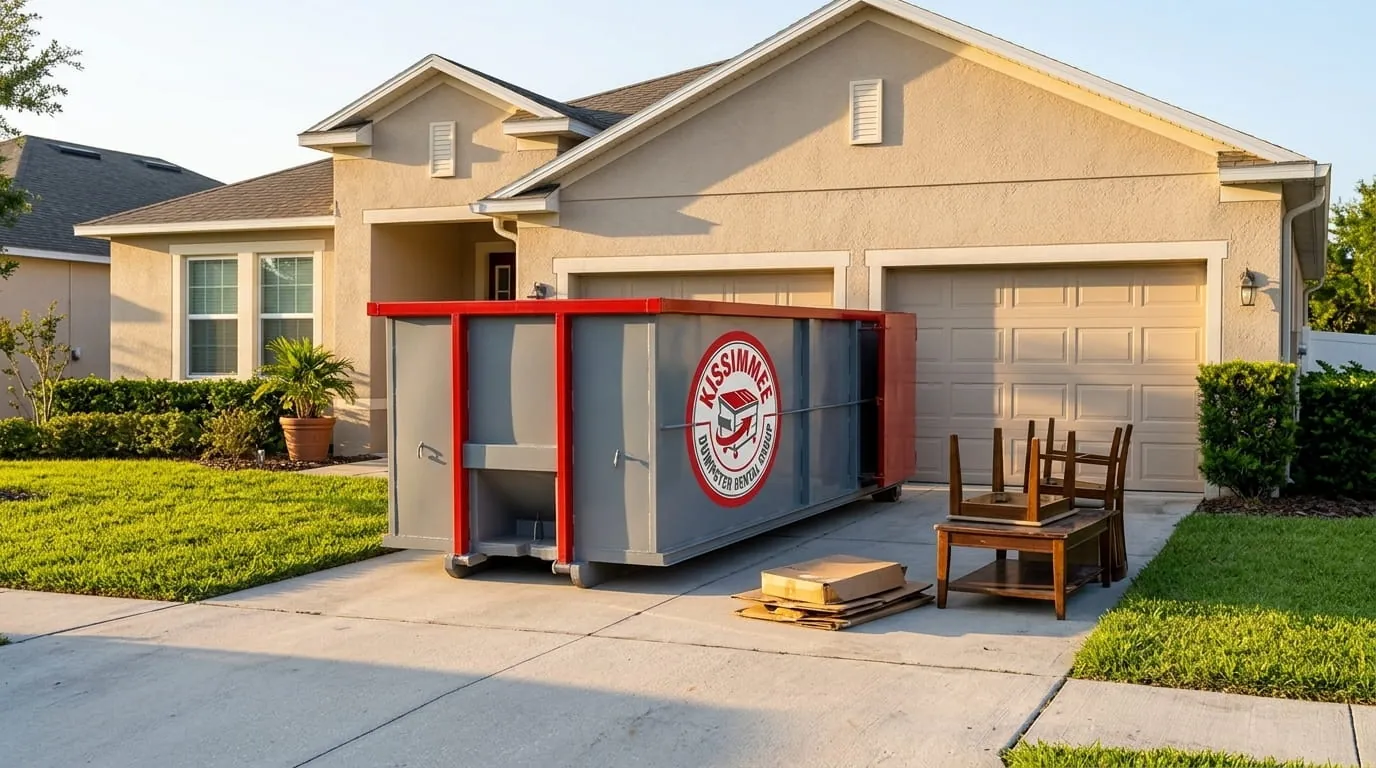
If your dumpster is going on your own driveway or your own private property, you almost certainly do not need a permit. That covers the overwhelming majority of the containers we place across Osceola County.
If it has to sit on a public street, a sidewalk, a swale or any other part of the public right of way, you will need one — and which office issues it depends on the parcel, which is where it gets interesting in Kissimmee specifically.
Private property: no permit
A driveway, a private parking area, a fenced construction site, a commercial lot you own or lease — all private property, no municipal permit required for the container itself.
Two caveats that are not permits but function like them:
- The underlying work may need a permit. Roofing, structural demolition, electrical, plumbing, additions and exterior alterations generally do. The dumpster is the easy part; sort the building permit first.
- Your HOA may have rules. These are private covenants rather than law, but they are enforceable and in some Osceola County communities they are enforced actively.
Public right of way: yes, permit
Placing a container in the street means occupying public space, and every jurisdiction in this region regulates that. The permit exists for sensible reasons: emergency vehicle access, sight lines at junctions, drainage, and making sure the container is reflectorised and identifiable at night.
Typical conditions attached to a right-of-way permit include a defined duration, reflective markings on the container, a minimum distance from intersections and fire hydrants, and a requirement not to obstruct drainage or sidewalks.
Our honest advice: if there is any way to get the container onto private property, do that instead. It is faster, cheaper and involves no paperwork. Street placement is a last resort for sites that genuinely have no other option.
The Kissimmee addressing trap
This one catches out more people than anything else in this article.
The postal service assigns a Kissimmee address to a large area that extends well beyond the city limits. Communities like Buenaventura Lakes, much of Campbell, large parts of the Poinciana corridor and substantial areas along US 192 west of town carry Kissimmee addresses while sitting under Osceola County jurisdiction.
Practically, this means calling the City of Kissimmee about a permit for a property that turns out to be county — and being told, correctly, that they cannot help you. It is not a big problem, but it costs a phone call and sometimes a wasted trip.
If you need to know for certain, the City of Kissimmee Development Services Center can confirm whether an address is inside city limits, and the Osceola County Property Appraiser's parcel records show the jurisdiction directly.
Who to call, depending on where you are
| Where the property is | Who issues right-of-way permits |
|---|---|
| Inside City of Kissimmee limits | City of Kissimmee, Development Services Center, 101 Church Street — Engineering issues right-of-way permits |
| Unincorporated Osceola County | Osceola County (Public Works / Development Review) |
| City of St. Cloud | City of St. Cloud Public Works |
| Hunters Creek, Meadow Woods | Orange County |
| Lake Nona | Mostly City of Orlando |
| Davenport, Haines City | The relevant city, or Polk County if unincorporated |
| Loughman, Four Corners (Polk side) | Polk County |
Useful direct links: the City of Kissimmee right-of-way permit page and the Osceola County Solid Waste department.
HOA and community association rules
In much of Osceola County the HOA matters more in practice than the municipality, because almost nothing we do requires a city permit but a great deal of it happens inside deed-restricted communities.
The rules vary but the themes are consistent:
- Duration limits. Many associations expect a container to be removed within a defined window, or simply “promptly on completion”.
- Placement. Driveway rather than street or swale, almost universally.
- Advance notice. Some associations want to be told before delivery.
- Appearance. Load kept below the rail, site kept tidy, no overflow.
Specific communities worth knowing about: the Association of Poinciana Villages enforces its covenants actively across all nine villages. Celebration has an architectural review process and narrow alley-served streets where placement genuinely matters. Reunion and ChampionsGate have gate-managed access and clear expectations about visibility.
None of this stops you renting a container. It just means a short conversation with your association before delivery day, which is far easier than a violation letter afterwards.
Gated and resort communities
Practical rather than regulatory, but it comes up constantly out toward Four Corners, ChampionsGate and Reunion. To get a truck through a gate we need either a code, a place on the visitor list for the delivery date, or a phone number for a call-in gate. Give us that at booking and it is a non-event. Leave it and the driver sits at a barrier.
What we need from you
When you call, tell us:
- Whether the container is going on private property or the street
- Whether you are in a deed-restricted community
- Any gate code or access arrangement
- Whether the underlying work is permitted, if it needs to be
If street placement turns out to be necessary, we will tell you which office to approach and what they typically ask for. We cannot pull the permit on your behalf — it attaches to the property owner or contractor — but we can make sure you are asking the right authority the first time.
Regulations change. Everything above reflects how these authorities operate at the time of writing, but ordinances get amended. For anything consequential, confirm directly with the relevant office before you rely on it.
Need a container in Kissimmee?
Call and describe the job. Three minutes on the phone gets you a size recommendation, a flat rate and a delivery window — and we will tell you if a smaller, cheaper container is the right answer.
Call (689) 215-8855