
Sizing
What Size Dumpster Do I Need? An Honest Kissimmee Sizing Guide
Most sizing guides tell you about cubic yards. That is the least useful number, because almost nobody can estimate their own debris in cubic yards. Here is how we actually do it on the phone.
Why cubic yards is the wrong question
Every dumpster sizing guide on the internet opens the same way: a 10 yard holds ten cubic yards, a 20 yard holds twenty, and so on. This is true and almost completely useless, because nobody standing in their garage looking at thirty years of accumulated stuff can convert that into cubic yards.
What we actually ask on the phone is three questions. What are you throwing away? How much of it is there, in terms you can picture — pickup loads, rooms, squares of roof? And where is it going to sit? Those three answers get us to the right container about ninety-five percent of the time, and the two questions after that are about weight.
The two constraints: volume and weight
Every container has two limits and you will hit one of them first. Volume is the obvious one: the box is only so big and you cannot legally load above the top rail. Weight is the one people forget, and it is the one that costs money.
Each size we run comes with an included tonnage. A 10 yard typically includes one to two tons, a 30 yard four to five. Go over and you pay a per-ton overage rate — which we quote before you book, so it is never a surprise, but it is still money you did not need to spend.
The rule that follows is simple and it is the single most valuable thing in this article:
What each size really holds
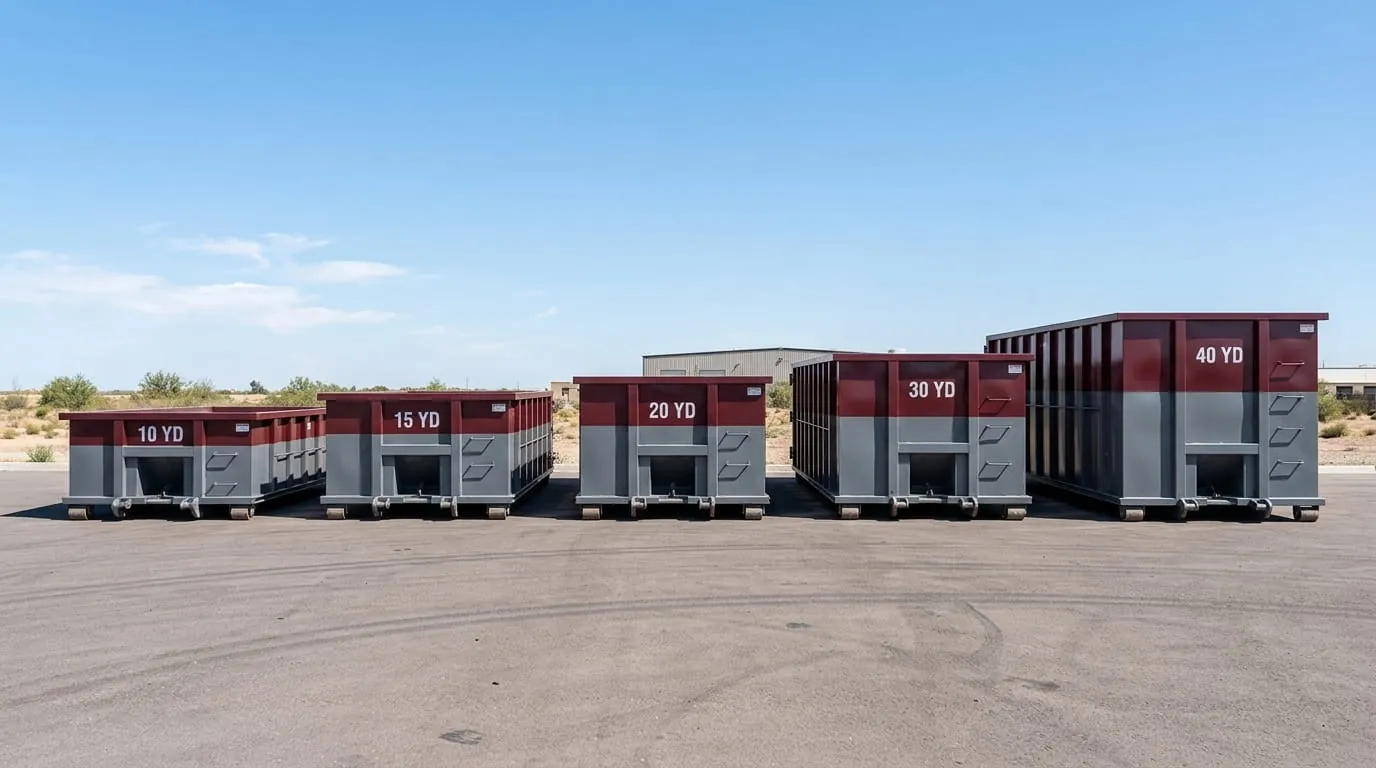
10 yard — 12 ft × 8 ft × 3.5 ft
Three to four pickup loads. One to two tons included. This is the small-job container and, far more importantly, the heavy material container. A guest bathroom gut. A garage clearout. A pool deck. Broken concrete, ceramic tile, brick, block. Low three-and-a-half-foot sides mean you can throw material over the wall without a ramp, which matters when you are handling broken slab by hand.
15 yard — 16 ft × 8 ft × 4 ft
Five to six pickup loads. Two to three tons. The most under-used size in the industry and frequently the right one. A great many callers ask for a 10, describe the job, and turn out to need around thirteen yards. Before the 15 existed as a common size, those people booked a 20 and paid for space they never used.
20 yard — 22 ft × 8 ft × 4.5 ft
Seven to eight pickup loads. Three to four tons. Our most popular container by a wide margin, because it covers the three most common real-world projects: a single-layer shingle re-roof, a full kitchen renovation, and a three-bedroom whole-house cleanout.
30 yard — 22 ft × 8 ft × 6 ft
Ten to twelve pickup loads. Four to five tons. Same footprint as the 20 with eighteen more inches of height, so it holds half again as much without needing any more driveway. The builder's container. Also the right call for a full vacation home refurnish, where you are shifting mattresses, sofas and pool furniture — enormous volume, very little weight.
Worked examples from real Kissimmee jobs
| Job | Size | Why |
|---|---|---|
| Guest bathroom gut with floor tile | 10 yard | Small volume, but tile and a cast iron tub are heavy |
| Screen room / lanai strip-out | 15 yard | Bulky aluminium and furniture, low weight |
| Kitchen renovation, mid-size | 15–20 yard | Cabinetry eats volume; tile floor pushes weight up |
| Shingle re-roof, 28 squares, single layer | 20 yard | Roughly 4 tons of shingle — at the allowance limit |
| Barrel tile re-roof, same house | 10–15 yard | Tile is 2–3× the weight per square |
| Pool deck concrete removal | 10 yard | Concrete is ~2 tons per cubic yard |
| Three-bed whole-house cleanout | 20 yard | Furniture and mattresses eat volume fast |
| Five-bed vacation home refurnish | 30 yard | Maximum volume, minimal weight |
| New build framing waste | 30 yard, swapped | Continuous volume across the build programme |
The Florida weight traps
Four materials catch people out here more than anywhere else, and three of them are specific to how we build in Central Florida.
Concrete and block
Roughly 4,000 pounds per cubic yard. A single cubic yard of broken slab weighs as much as a small car. This is why we will not put concrete in anything larger than a 10 yard, and why we will tell you to stop filling at somewhere between half and two-thirds.
Barrel and concrete roof tile
Extremely common on the 1990s and 2000s housing across Celebration, ChampionsGate, Reunion and much of the vacation home market. A square of concrete tile can weigh two to three times what a square of architectural shingle weighs. Sizing a tile tear-off like a shingle tear-off is the most expensive mistake we see.
Paver bedding sand
If you are lifting a paver driveway or patio, the pavers are heavy and the two inches of bedding sand underneath them is heavier still. People budget for the pavers and forget the sand entirely, and then the load comes in a ton over.
Wet vegetation
Freshly cut green material holds a lot of water, and a Florida afternoon storm on an open container adds more. If your yard waste can dry for a few days before it goes in, it will weigh noticeably less. If the container is going to sit open through a wet week, mention it when you book.
When to size up and when to size down
Size up when the material is light and bulky — furniture, mattresses, drywall, cabinetry, packaging, screen frame, carpet. The price difference between sizes is smaller than the capacity difference, because much of what you are paying for is the truck movement rather than the box. If you are genuinely borderline on a light load, the bigger container is usually better value.
Size down when the material is dense — concrete, tile, plaster, brick, terrazzo, soil, wet vegetation. A bigger container here does not help you. It just gives you enough space to become illegally overweight.
Size down also when the driveway genuinely will not take the length. A 20 yard needs twenty-two feet plus roughly ten feet of clear run behind it for the truck. On the older narrow drives in Buenaventura Lakes or the original St. Cloud grid, a 15 yard often makes more practical sense than a 20 you have to park across the sidewalk.
Two smaller containers vs one big one
On larger jobs this is frequently the cheaper route, and almost nobody asks about it.
Disposal is priced by stream. Mixed construction and demolition debris costs more per ton than clean concrete, which goes to a recycler and becomes road base. Clean dimensional lumber, clean cardboard and scrap metal are all cheaper to dispose of than mixed waste, or in the case of metal, sometimes worth money.
So on a demolition job producing both concrete and general debris, two containers — one clean concrete in a 10 yard, one mixed in a 20 — will very often cost less in total than a single mixed 30 yard, even though you have paid for two container movements. On a big build with separated streams the saving can be substantial.
The test is whether you have enough of a clean stream to justify a dedicated container. Half a container of clean concrete, yes. A wheelbarrow full, no — just put it in the mixed can.
How to describe your job on the phone
You do not need to work any of this out yourself. What helps us most is:
- What the material is. “Kitchen cabinets, countertop, appliances and about 200 square feet of tile floor” tells us everything.
- Roughly how much. Rooms, squares of roof, or pickup loads — whichever you can picture.
- Where it is going. Driveway, street, job site, and what the surface is.
- Anything unusual. Low branches, pavers, a gate code, a short drive, a septic field, a slope.
That is a ninety-second conversation and it is the difference between a flat rate that holds and an estimate that moves. If you are anywhere in Osceola County, south Orange County or the north Polk corridor, call and describe the job — we will size it honestly, including telling you when a smaller and cheaper container is the right answer.
Need a container in Kissimmee?
Call and describe the job. Three minutes on the phone gets you a size recommendation, a flat rate and a delivery window — and we will tell you if a smaller, cheaper container is the right answer.
Call (689) 215-8855